
Philosophy as Branding: How FRAMA Creates Cultural Resonance
Branding has changed dramatically with the rise of social media and the constant influx of trends. Consumers are increasingly aware of when they’re being sold a product and when they’re being offered an experience. The brands that succeed in the long run are those whose practices are rooted in honesty, community, and a commitment to quality and longevity.
In this article, we explore how design is evolving and how brands like FRAMA are redefining what it means to create objects and experiences with people at the center. To better understand how FRAMA cultivates cultural resonance through its design approach, VOCAST spoke with Paulina Melinauskaite, the brand’s PR and Activations Manager.
Algorithms have fundamentally reshaped the way we decorate our homes. Styles like cottagecore and Japandi spread through social media so swiftly that they no longer feel like genuine expressions of taste, but rather formulas for interiors that look eerily flat.
As Diet Prada’s founder — of the fashion watchdog and commentary platform — observed in The World of Interiors, we’re no longer cultivating taste so much as staging it. Trends don’t grow gradually anymore; they appear overnight, get copied, shared, and re-created until they burn out; often before they’ve had time to mean anything at all. What gets lost in this constant cycle of influence and consumption is the act of asking why. Why this object, and not another? Why bring it into your life at all? The hyper-consumerism spurred by a never-ending stream of trends collapses wanting into needing, leaving little room for reflection.
Increasingly, brands themselves overlook these questions, addressing us as consumers first and people second. This raises a deeper challenge for design: how can a brand craft meaning, not just objects? How do you create pieces that outlast trends in an era defined by disposability?
FRAMA: A philosophy of Care
One studio that has managed to let its philosophy guide its practice is VOCAST partner FRAMA. Founded in 2012 by Niels Strøyer Christophersen in Copenhagen, the multidisciplinary studio creates objects for the home: furniture, lighting, scents, and personal care items, with a focus on timelessness and craftsmanship.
To better understand how FRAMA cultivates cultural resonance through its design approach, Vocast spoke with Paulina Melinauskaite, the brand’s PR and Activations Manager.

Meet Paulina Melinauskaite

Since joining the company over three years ago, Paulina has focused on building, nurturing, and developing its creative community by hosting events and crafting spaces that invite genuine connection. With a master’s degree in Fashion Business from Polimoda and experience at Gucci 9, she brings a deep understanding of both brand storytelling and customer experience, reflective of FRAMA’s philosophy of designing not just objects, but meaningful experiences.
FRAMA’s Design Ethos
The FRAMA universe is deeply immersive; a visit to its store in the heart of Copenhagen offers a sensory experience centered on the interdependent meaning of objects. Brands can learn from this kind of storytelling, one that encourages people to engage with the history of a space, fostering connection and integrating them into something larger.
Paulina shares how such value arises not only from the beauty of an item itself, but from how it interacts with its surroundings to create a sensory whole:
“Beyond our core collections—the 01 Series, Shelf Library System, Farmhouse Series, Rivet Series, and Tasca—our universe extends into all aspects of life. Our Care line, for example, wasn’t conceived to fill a product gap, but to explore sensorial storytelling.”
Such sensorial storytelling is woven into all projects conceived by FRAMA, with Paulina sharing the experience of designing the first scent, “Apothecary”:
Launched in 2016, the scent drew inspiration from St. Pauls Apotek, a historic wood-lined pharmacy in Copenhagen. Each fragrance is designed to invigorate the senses and bring object permanence into interior space—self-care that bridges space and scent. Even the containers are designed as an extension of the “FRAMA universe”.

A Focus on Materials
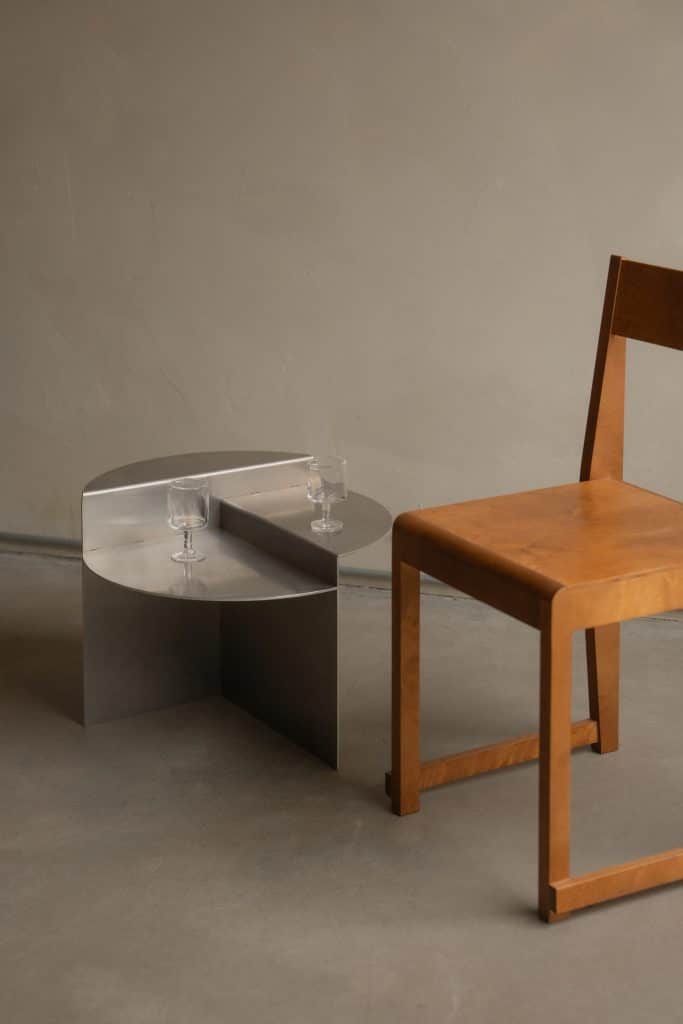
In FRAMA’s world, form is never divorced from function, and beauty is always rooted in the material. The studio defines some of its pieces as “utilitarian,” created for everyday living. They offer a sense of functional simplicity; objects that adapt naturally to their surroundings.Paulina expanded on the studio’s sensibility:
“If you use quality ingredients, you can rarely mess it up,” founder Niels Strøyer Christophersen has said. The design process remains deeply instinctive—guided by curiosity and rooted in honesty. The team favors unexpected discoveries, spontaneous collaborations, and natural materials that age beautifully.
Community Expansion
From its home in Copenhagen, FRAMA has grown into a global network, reaching more than 50 countries through subsidiaries and exclusive distributors. Its first international retail space recently opened in Tokyo, marking a quiet but deliberate expansion. But FRAMA’s growth isn’t about scale. It’s about relationships.
“Much of it comes down to authentic collaboration,” Paulina shares. “We produce where the craft is strongest—Denmark, Italy, Portugal, and sometimes Japan or Korea. Many of our makers have practiced their trades for generations, reviving traditions through contemporary design.”
Collaborations, whether with Toogood, The Natural Wine Company, Kvänum, or Beni Rugs,don’t dilute the FRAMA identity. Instead, they broaden the scope. These partnerships introduce new perspectives and, in Beni’s case, entirely new product categories, all while staying anchored in FRAMA’s core values.
What makes FRAMA feel timeless is its refusal to rush. Rather than chasing what’s new, it stays close to what matters: materials, people, and a sense of place. In a world that moves quickly, FRAMA moves with care. As Paulina reflects, “We’ve always sought to translate objects and spaces into human experiences. Our community values mindful living, design that lasts and evolves, not design that performs trends.”
In an age where branding often veers toward spectacle, FRAMA offers a different proposition: slowness as strategy, care as ethos. In doing so, it challenges the dominant cycle of endless reinvention, asking instead: what endures?
This commitment to permanence is what gives FRAMA its cultural weight. More than a brand, it operates as a philosophy, rooted in presence, not persuasion. It’s not an anti-modern or nostalgic approach. It’s honest. By grounding its work in care and attention, FRAMA reminds us that design, most importantly, has the capacity to feel human.
References: Image: Frama Image Bank. World of Interiors: Clickbait to Cliche. Frama: Material Guide

Alexandra Melekki is the U.K. Media Researcher at VOCAST. She has a Bachelor’s degree in Business and Digital Management from CBS and is currently pursuing a Master’s degree in Strategic Design and Entrepreneurship at the Royal Danish Academy.
This article was published on the 27th of October 2025.
Want to learn more about these curated lists? Feel free to contact us.
RELATED POSTS
Protected: UGC: Why Are Brands Trading Perfect Studio Shoots for Authentic, Lived-In Content?
Password Protected
To view this protected post, enter the password below:

The product isn’t sold until your partner sells it
Linus Bohlin has bought brands, sold a brand, and is now building one. From all three seats, the same lesson keeps surfacing: the brands that resellers sell hardest are the ones that make their product data and content easiest to use. Most people in this industry...

3daysofdesign Lasts 72 Hours. Your Showroom’s Impact shouldn’t.
Design festivals are fast-paced, highly compressed, and intensely competitive. To stand out among hundreds of exhibitors during Copenhagen’s 3daysofdesign, forward-thinking brands must look beyond physical square footage. By transforming your digital showroom into a...

